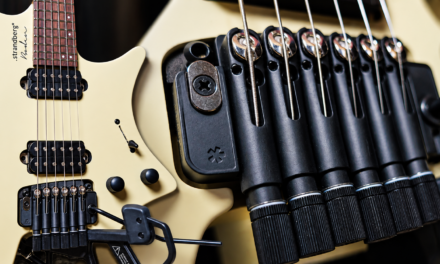
These instruments aren’t necessarily designed to replace a traditional guitar. Instead, they’re rethinking what a guitar-like instrument can be.
Stringless smart guitars are one of the most interesting new categories in guitar technology. These instruments take the familiar concept of playing guitar and combine it with digital sounds, built-in speakers, apps, MIDI, backing tracks, and ultra-portable designs.
For this comparison, I spent real hands-on time with four of the most interesting smart guitars available today: the Enya Cyber G, Lava Genie, LiberLive C1, and Aeroband Guitar. Rather than picking one overall winner, I’m breaking down what makes each instrument different, who it’s best suited for, and which one makes the most sense for you.
What Is a Smart Guitar?
Smart guitars take the basic ergonomics of a traditional guitar and combine them with electronic and digital features. Instead of relying entirely on strings and traditional pickups, these instruments can use touch-sensitive fretboards, buttons, digital sounds, built-in speakers, apps, rhythm loops, and in some cases MIDI connectivity.
They’re also designed to be extremely portable. Several of the guitars in this comparison have removable necks or folding designs, making them much easier to take on a trip, bring to a friend’s house, or use for songwriting and practice.
What Do These Smart Guitars Have in Common?
The Enya Cyber G, Lava Genie, and LiberLive C1 share a similar basic concept. Each uses a guitar-style neck with seven customizable playing positions that function somewhat like frets, allowing you to play chords and melodies without traditional strings.
They also offer basic and advanced playing modes. Basic mode generally gives you one note per position, while advanced modes allow multiple notes to be assigned to each position for more complex chords and playing styles.
All four instruments also include built-in speakers and some form of rhythm or backing functionality. However, the way you actually play each one is quite different, which is where the personalities of these instruments really start to emerge.
Enya Cyber G

The Enya Cyber G is arguably the most experimental instrument in this comparison. Its biggest advantage is modularity, allowing you to change the controller on the body depending on how you want to play.
Cyber G Features
- Modular controller system
- Keyboard and chord-pad modules
- Seven-position touch-sensitive fretboard
- Basic and advanced playing modes
- Built-in rhythm and looper
- Intelligent bass functionality
- Built-in speaker system
- Bluetooth connectivity
- USB-C audio and MIDI connectivity
- 20 built-in instruments and hundreds of app tones
- Approximately 5-6 hours of battery life
The modular design is what separates the Cyber G from the other guitars here. The keyboard module can be removed and replaced with a paddle and chord-pad module, giving you different ways to interact with the instrument.
The keyboard can also function as a MIDI controller through USB-C, making the Cyber G particularly interesting for producers and musicians who already work with a DAW.
How Does the Cyber G Sound?
The Cyber G leans more toward being an electronic instrument than trying to perfectly recreate the experience of an acoustic guitar. That’s not necessarily a negative. In fact, it’s one of the reasons I like it.
The built-in speaker is one of the better sounding speakers in this comparison, with enough volume and clarity to make the instrument enjoyable without connecting it to another system.
Who Is the Cyber G For?
The Enya Cyber G is the best choice here for producers, keyboard players, sound designers, or guitarists who want to experiment with electronic instruments. The modular design gives it a level of flexibility that the other models simply don’t have.
Lava Genie

The Lava Genie takes a completely different approach. Instead of trying to replicate the feel of a traditional guitar, it focuses on making the instrument as accessible and immediately fun as possible.
Lava Genie Features
- Stringless touch-based fretboard
- Seven-position playing system
- Basic and advanced modes
- Individual note and chord pad
- Built-in drum loops
- Built-in dual-driver speaker system
- USB-C connectivity
- Headphone output
- Quarter-inch instrument output
- Lava Plus app connectivity
- 10,000 licensed songs in the app
- Detachable neck and folding body
- Approximately $399 list price
The Genie is probably the easiest of these instruments to pick up and start making music with. The silicone fretboard is extremely soft, and the playing system feels more like interacting with a game controller than learning traditional guitar technique.
Lava Plus App
The Lava Genie connects to the Lava Plus app, which provides presets, lighting customization, chord charts, songs, and other features. The app also includes a large library of licensed songs.
Some of the more advanced features require a subscription, so the app experience isn’t completely free. That’s something to keep in mind if you’re considering the Genie as a long-term instrument.
How Does the Lava Genie Sound?
The Genie has the weakest built-in speaker of the four instruments in this comparison. It doesn’t get quite as loud as the competition, and the speaker doesn’t have the same level of quality as some of the other models.
Where the Genie makes up for that is in its accessibility. The synth sounds are particularly fun, and the overall experience makes it easy to start experimenting with music almost immediately.
Who Is the Lava Genie For?
The Lava Genie is the best choice for beginners, kids, casual players, or anyone who wants an instrument that is extremely easy to pick up and play. If you’ve never played guitar before, this is arguably the easiest entry point into the category.
LiberLive C1

The LiberLive C1 takes the smart guitar concept in a more guitar-oriented direction. It retains the portability and digital features of the other instruments but puts a greater emphasis on simulating the experience and sound of an acoustic guitar.
LiberLive C1 Features
- Foldable one-piece neck
- Seven-position stringless fretboard
- Basic and advanced playing modes
- Individual note pad
- Paddle-style strumming control
- Built-in drum loops
- Transpose control
- Built-in speaker
- Completely free companion app
- 100+ rhythm sounds and patterns
- Backing tracks and looping tools
- Interactive chord sheets
- Approximately $449 list price
The foldable neck is one of the C1’s biggest advantages. Unlike the other guitars that require you to remove the neck, the C1 folds into a remarkably compact package and can be ready to play in seconds.
The LiberLive Playing Experience
The paddle system is one of my favorite parts of the C1. It provides physical resistance when you strum, making the experience feel more like actually playing a guitar than simply pressing buttons.
The individual note pad also makes it possible to simulate fingerpicking and play individual notes. Combined with the interactive chord system, the C1 can be particularly useful for learning and songwriting.
How Does the LiberLive C1 Sound?
For me, the C1 has the most convincing acoustic guitar simulation of the four instruments in this comparison. If you’re specifically looking for a smart guitar that can provide an acoustic-like playing and listening experience, this is the standout.
The built-in speaker is also loud enough for casual performances without requiring a PA. There is no standard quarter-inch instrument output, but the line output can be adapted for connection to a larger sound system.
Who Is the LiberLive C1 For?
The C1 is an excellent choice for songwriters, singers, learners, and performers who want something portable with a more authentic acoustic experience. It’s particularly compelling for singers who want an instrument they can use to accompany themselves without learning traditional guitar technique.
Aeroband Guitar

The Aeroband Guitar is the most traditional-feeling instrument in this comparison. While it is still a smart guitar with no strings across the fretboard, it uses a more familiar guitar layout and even includes six physical strings at the bottom for strumming.
Aeroband Features
- Traditional guitar-style fretboard
- Physical strumming strings
- Built-in speaker
- MIDI controller functionality
- Capo function
- Alternate tunings
- USB-C connectivity
- Quarter-inch output
- Headphone output
- Microphone input
- Free Aeroband app
- Approximately 10-12 hours of battery life
- Detachable neck
The Aeroband is clearly designed with experienced guitar players in mind. The fretboard layout feels much more familiar than the other instruments, and you actually fret chords in a way that is closer to playing a conventional guitar.
MIDI and Digital Integration
The standout feature of the Aeroband is its MIDI functionality. You can connect it to a DAW and use the instrument as a MIDI controller, opening up sounds and possibilities that would normally require a keyboard or dedicated MIDI controller.
This can be particularly useful for guitarists who understand the fretboard but don’t play keyboard. You can use your existing knowledge of guitar shapes to trigger different digital instruments and sounds.
How Does the Aeroband Guitar Sound?
The Aeroband does a surprisingly good job with its acoustic simulation. Open chords sound convincing, although some of the more advanced hammer-on and hammer-off techniques can start to sound more like a keyboard or MIDI instrument.
The built-in speaker is also surprisingly loud and compares well with the Cyber G. The instrument has enough connectivity to work for practice, recording, or live performance.
Who Is the Aeroband For?
The Aeroband is the best choice for experienced guitarists who want digital integration without completely abandoning the familiar guitar experience. If MIDI is a major priority, this is one of the most compelling instruments in the group.
Smart Guitar Comparison
Which Smart Guitar Should You Buy?
Choose the Enya Cyber G If…
You want the most experimental and flexible instrument of the group. The modular controller system makes the Cyber G especially interesting for producers, keyboardists, and guitarists who want to explore sounds beyond traditional guitar.
Choose the Lava Genie If…
You want the easiest instrument to pick up and start playing. The Genie is approachable, fun, compact, and particularly well suited to beginners and kids.
Choose the LiberLive C1 If…
You want the most convincing acoustic guitar experience. The C1 combines excellent portability with a physical strumming system, strong acoustic simulation, and a completely free companion app.
Choose the Aeroband If…
You’re already an experienced guitarist and want digital integration. The Aeroband’s familiar fretboard and MIDI capabilities make it the most natural choice for guitarists who want to bring their existing playing skills into a digital environment.
Smart Guitar Shootout: Final Thoughts
After spending real time with all four instruments, I don’t think there’s a single winner. That’s actually what makes this category so interesting.
The Enya Cyber G is the experimental option, the Lava Genie is the easiest and most accessible, the LiberLive C1 provides the most convincing acoustic experience, and the Aeroband is the strongest choice for experienced guitarists who want MIDI and digital integration.
These instruments aren’t necessarily designed to replace a traditional guitar. Instead, they’re rethinking what a guitar-like instrument can be and giving musicians completely new ways to practice, write, perform, and experiment.
If you’re interested in smart guitars, the best choice really comes down to how you want to use one. Whether you’re a beginner looking for an easy introduction to music, a songwriter looking for a portable writing tool, or an experienced guitarist looking for a new MIDI controller, there’s an option here that could make a lot of sense.
And that’s what makes the current smart guitar market so exciting. These instruments are taking familiar ideas and combining them with technology in ways that can open up entirely new creative possibilities.
Ready to Get One?
If you decide to purchase this gear, consider using one of my affiliate links below. It won't cost you anything extra, and your purchase helps support Music for Miles and future gear reviews.